



Quick background
I graduated from Babson in 2026 and work in Global Markets Credit at BofA in New York, covering regulated fund counterparties. Before that: hedge fund credit coverage in Chicago in summer 2025, a product internship at Perplexity after they acquired Carbon, a summer in mortgages, and an economics research assistant job at Babson.
I also spent two of my college years abroad. Junior year at Yonsei in Seoul, senior year at Tsinghua in Beijing. I speak Mandarin, and my Korean is functional on a good day. Honestly those two years matter more to this site than anything on the resume, because most of my book is geopolitics, and I got to watch the semiconductor and AI buildout from inside the two countries where it is actually happening. Korea treats chip fabs like national champions. In Beijing, export controls and chokepoints are not abstractions in a research note, they come up at dinner. When I price a Hormuz contract or a Chinese minerals headline, that is the lens I am using.
The path here
Mortgages was my first look at how a price is really a stack of assumptions. Prepayment behavior, rate paths, credit curves. Move one input and the whole number moves. A binary event contract behaves the same way when a single condition on the ground shifts.
At Perplexity I worked on data connectors for GenAI systems, where retrieval quality decides what the model ends up believing. Prediction markets have the human version of that problem. The information is public. Almost nobody does the retrieval.
The two credit seats tied it together. Counterparties do not get judged on whether one view was right. They get judged on exposure, margin behavior, and what happens in the tail. That is why the stats pages here care so much about sizing, drawdowns, and the difference between a resolved hold and a swing, and much less about any single call.
"I wanted a place to think clearly about prediction markets without being lumped in with the degens."
Why "the Scoop"?
The name comes from poker, which also funded my first trades. Scooping the pot means winning the whole thing, high and low, usually because you read the table better than everyone else did. Binary contracts work about the same way unless you exit early. You win the pot, or you learn.
How I look for edge
I look for markets where the implied probability has come loose from what the observable data actually shows, usually because the crowd is trading a headline instead of a condition. Insurance premiums, port transit data, legislative calendars, toll frameworks. All of it is public, but interpreting it takes work that most participants skip, and political and macro markets have far more of these gaps than sports does.
It also helps that I am not competing with quant firms over microsecond spreads here. These venues are still small enough, and still carry enough stigma, that fundamental thesis work and basic expected-value discipline pay. There is a type of person who treats these markets like a casino and a type who treats them like an analytical problem. This site is the record of trying to be the second type.
The skill I'm building
The one I actually care about is updating. Being right about a thesis matters less than noticing when the thesis has stopped being true. This site is where I track how that is going, in public, with the record intact whether it flatters me or not.
See how this works in practice
Start with the current Hormuz normalization thesis for the full version.
View featured tradeAlso building
Ante
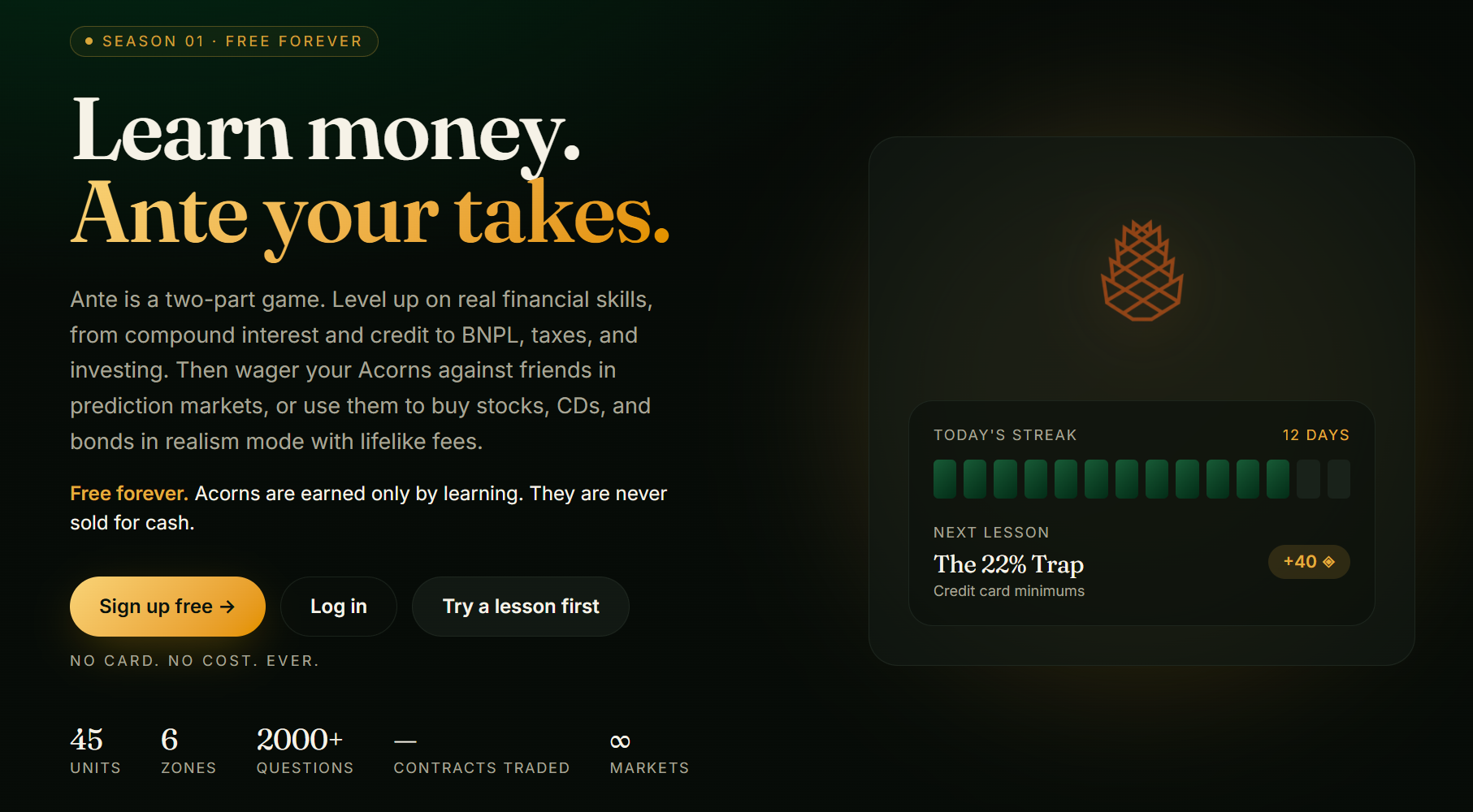
A financial literacy game where learning mints the currency. Complete lessons on compound interest, credit, taxes, and investing to earn Acorns, then wager them in invite-only markets or invest in a virtual brokerage with realism mode.
Because I am inside BofA, I am also exploring a partnership where verified completion of Ante curriculums unlocks real banking benefits: opening a Merrill trading or brokerage account, a checking account, high-yield savings, or similar products. The goal is to bridge learning and doing, so finishing a lesson actually leads to a working account.